
Digital technology has fundamentally changed the way of life of Chinese people. The new form of digital economy also requires the media industry to reformulate effective information usage methods to attract their users. And media companies must act quickly because the digital media economy has become the mainstream of the media industry, and it continues to grow at a rapid rate.
Here is a video comparing new media with traditional media:
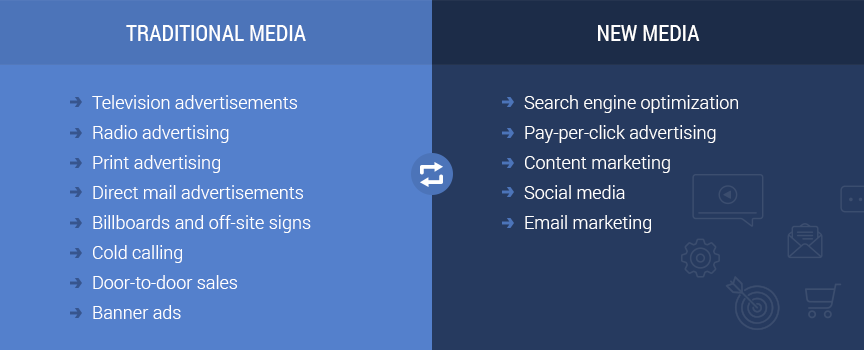
From:WebFx
Three significant changes have occurred in the field of media combined with the digital economy in China:
First, the source of news has changed from a professional organization to every individual. In the past, when an emergency occurred, a professional media reporter would report and release the first time.These professional media platforms are news sources,but now everyone can become a news source and everyone can participate in the release of information in China. People use social platforms such as WeChat and Weibo, and the information posted on them will soon be disseminated, and then the professional media will follow the report.
In China, the widespread use of social media is gradually depriving traditional media of monopoly over public discourse. On the positive side, the relatively high degree of freedom from the media allows new information to appear in public media, which is unable to find in traditional media. (Tong and Sparks 2009; Yang 2009; Xin 2010; Xiao 2011). The extensive use of self-media has also eased that some news in China is too sensitive to be released on traditional media in a timely manner. Journalists now have to compete with new media with more professional perspectives and deeper content.
Second, restrictions on content access are reduced. In the past, whether people read a newspaper, a radio or television program, there were border restrictions. Newspapers have limited number of pages, and radio and television are broadcast only during specific time periods. However, now that mobile phones can be used to receive information anytime and anywhere. People no longer have restrictions on access to content, and the restrictions on the distribution of information and advertising in the media industry have also decreased. More and more advertisers are finding digital media more attractive than traditional media.
Third,the repetition of information is increased. Traditional media are limited by information boundaries. In order to avoid publishing too much of the same information at the same time, they will filter the information and publish it. Each media will guarantee its own personality.But New media is the opposite. Because there are no boundaries, a large number of similar or similar media platforms are active at the same time. When a news item appears, they will try to push all kinds of information in order to ensure that their platform information is timely. Therefore, a user often receives same message on different platforms.

Mobile phones and computers are widely and widely used in China. They allow people to easily view media messages and participate in and share information. Due to the increase in network speed and better file sharing technology, media publishing news in the form of video has become a feasible method. Video not only improves the receiving efficiency of users, but also increases the richness of information. As never before, video has become a very important method in media operations and news release.
The traditional media industry represented by newspapers is suffering a huge impact.In the last couple of years, this growth has halted for most titles: overall circulation is declining and the share of advertising expenditure going to the press has begun to fall (General Administration of Press and Publication (GAPP) 2005–2015; WARC 2014) .Since 2012, the total circulation of newspapers has been accelerating, especially in business newspapers. The overall circulation of Chinese newspapers fell by almost 11% in 2013 and by 25% in 2014.
The newspaper industry is facing tremendous pressure from the emerging economy. In order to remain competitive, many newspaper companies have readjusted their reporting strategies. A large number of traditional media practitioners leave traditional media to enter online media or become self-media producer.
At present, China’s digital media form has entered a relatively mature stage, and large-scale network media operators have monopolized most of the media traffic. But the media industry is still advancing due to the development of digital technology.
Next, the media will begin to apply the next-generation Internet based on IPV6 and 5G. Its time period is from 2017 to 2030. The next generation Internet has many exciting technologies that can be applied in the media field, including IPV6, cloud computing, big data, Internet of Things, artificial intelligence, virtual reality, quantum communication, and other aspects.Big data media can more accurately distribute information and advertising, and artificial intelligence media companies can complete more interactions with users, and virtual reality may completely change the way the media releases information.
Technology changes sometimes faster than information can be generated.
References
Keane, M. (n.d.). China’s digital media industries and the challenge of overseas markets. JOURNAL OF CHINESE CINEMAS.
Li, K., & Sparks, C. (2018). Chinese Newspapers and Investigative Reporting in the New Media Age. Journalism Studies, 19(3), 415–431.
Michael, D. C., & Zhou, Y. (2011). Understand and Tap Into China’s Digital Generations. China Business Review, 38(1), 22–26.
New Media Blue Book: China New Media Development Report (2019)
Ronald J. Deibert. (2019). The Road to Digital Unfreedom: Three Painful Truths About Social Media. 30(1), 25–39.
Vukanovic, Z. (2009). Global paradigm shift: Strategic management of new and digital media in new and digital economics. The International Journal on Media Management, 11(2), 81-90.wer
 Zewei Liu Blog
Hello Zewei Liu,
I have found your blog very interesting. The comparison between traditional and ‘new’, digital media using a video and a chart makes it clear and simple to comprehend the similarities and differences. I particularly agree on your statement that nowadays we are all somewhat social ambassadors who share and report news from our media devices. This has truly changed the way by which we access data and information. Moreover, I believe with the use of new media and the new tools used to share information, there will be less government censorship and freedom of expression will become more prominent in China. You are right, the future of the media industry is going to be disruptive and there is a lot in store for society at large, especially as you mentioned, with the rise of 5g, IPV6, cloud computing, big data IoT etc.
I look forwards to reading your future posts!
Take care,
Daniel Buhler
LikeLike
A really interesting insight into how technology and the digital economy have impacted the media industry in China. It seems like social media is having positive effects on those living in China, giving more people access to the media, more of the time. It would be interesting know how the Chinese government feels about the decline of traditional media, where there has traditionally been some censorship of information. Is the digital economy empowering the people in China?
LikeLiked by 1 person
In a way, yes, people have more opportunities to discuss real issues. Of course censorship still exists online.
In other words, we can understand that the digital economy form has released people’s desire to express opinions.
LikeLike
Nowadays, traditional media has to develop applications related to the Internet and social media in order to adapt to the majority of young users. At the same time, more and more personal media accounts have appeared, conforming to the development of the times。
LikeLike
Zewei made a comparison between the way that modern Chinese people use new technology to obtain information and the traditional way, which makes me very intuitive to feel that digital technology has brought about changes in the life and learning direction of the public! Thanks zewei for sharing
LikeLike
Thanks to Zewei for sharing, I learned about the development of such a comprehensive and interesting new media industry. You analyzed the development of China’s new media industry from three aspects. Among them, the one that most empathizes with me is “the repetition of information is increased”, because we have many repetitive and worthless information on social media every day. Because of repeated occurrence of information, information may be brainwashed in the subconscious, which is not conducive to the development of analytical ability and imagination.
LikeLike
Hello Zewei,
You imply that border restrictions over content being reduced, Chinese people benefits from better quality information’s, and digital media from a greater freedom in comparison with the traditional medias.
I wonder if this assumption is true. Control of the government over digital information in China began as soon as in 2004 with the imprisonment of the blogger Yong Tongyan. Moreover, even if the use of social medias Weibo or WeChat is widespread, they remain exclusively Chinese as foreign social media are forbidden. Moreover, studies stated that there is “an existing Internet censorship as well as ongoing regulatory restrictions over foreign media and journalists” ((Lindsay, Cheung and Reveron, 2015). The recent use of social credit system has additionally shown that digital technologies can be used to better control of behaviours.
Consequently, don’t you think that the improvement of digital cybersecurity and cybercontrol tools will increase the capacity of the government to filter the information in the future threatening digital medias independence?
Reference:
Lindsay, J., Cheung, T. and Reveron, D. (2015). China and Cybersecurity: Espionage, Strategy, and Politics in the Digital Domain. Oxford University Press.
LikeLiked by 1 person
Hi Alex,
I think the freedom of digital media should be observed from the perspective of receiving information and expressing opinions.
Chinese Internet users are restricted from accessing foreign Internet information, but in fact, high-quality and content that complies with Chinese regulations can still be seen by Chinese Internet users. While the netizens lost the flow of information, they also reduced a lot of worthless and false information.
In terms of expression, the development of digital media has definitely provided great convenience for people to express their opinions, although some opinions may exist on the Internet for a short time due to network supervision. It’s not good enough, but in fact progress is taking place, and managers will consider the opinions that appear on the Internet
In addition, as for the digital media information supervision, every country in the world is doing it. Of course, China should gradually improve in some aspects and certain measures.
LikeLike
Hi, I also followed some news about old and new media. Self-media is the part that I am more interested in. In addition to solving the problem of information monopoly, I think that information audit is also a relatively large problem. In the past, the traditional media information review would be more centralized, and it would be reviewed before it was disseminated. The news release of new media is scattered and large, and it is difficult to control information security or authenticity through the review of the publishing platform. Therefore, the freedom of information brought by the development of science and technology is not necessarily a good thing.
LikeLike
The role of media has been changing with the increasingly digitizing economy in China. I agree that the sources of news are now not restricted to professionals in the media sector. Anyone can be a source of news and therefore redundancy in the content of news has been increased. The restrictions on the content of news have been reduced which used to be there in the traditional media in China. Restrictions on the print media were high and those violating the censorship restraints were terminated or demoted from their positions. With the digitization in the economy, print media is under constant pressure to adapt itself to survive the intense competition. Present media is more independent, and people have easy access over the information online through their smartphones or other electronic devices. This indicates that the digital media in China at present has reached a more developed stage than before, however, it is still advancing in terms of introducing next-generation technologies for the upcoming years.
LikeLike